Tuesday, 23 December 2014

Linked Data for Libraries Project

"Welcome to the Linked Data for Libraries (LD4L) project. The project is a collaboration of the Cornell University Library, the Harvard Library Innovation Lab, and the Stanford University Libraries, and is funded by a nearly $1 million two-year grant from the Andrew W. Mellon Foundation.
The goal of the project is to create a Scholarly Resource Semantic Information Store (SRSIS) model that works both within individual institutions and through a coordinated, extensible network of Linked Open Data to capture the intellectual value that librarians and other domain experts and scholars add to information resources when they describe, annotate, organize, select, and use those resources, together with the social value evident from patterns of usage."
Aims to connect entities in descriptive metadata: People, Organisations, Places, Subjects, Events, Works, and Datasets.

The Linked Data for Libraries (LD4L) Project: a Progress Report: http://www.cni.org/pbs/the-linked-data-for-libraries-ld4l-project-a-progress-report/

Authority files: Breaking out of the library silo to become signposts for research information

Knowledge Exchange is exploring the rich field of research information in order to help our partners effectively achieve their objectives. To this end a group of experts collected examples of Authority Files, to demonstrate their working and immense value for information discovery and knowledge creation in the research process.

Authority Files or Controlled Vocabularies are lists of entities (publications, journals, data collections, organisations, etc.). The lists are uniquely identified by a number (identifiers such as ORCID for researchers, DOI for publications, ISBN for books, etc.) and contain information to characterise and qualify the entities (e.g. if a journal is Open Access, which researcher contributed to a specific project, etc.)
The lists are authoritative (maintained by an expert organisation, registry office, etcetera; or authoritative in itself being widely recognised and used by significant audiences, etc.) In this publication experts explain the beneficial value of Authority Files with regards to discovery, trust and reliability, accountability, transactional efficiency, for knowledge creation.

Download the publication: http://www.knowledge-exchange.info/Default.aspx?ID=708 

Monday, 22 December 2014

Sowing the seed: Incentives and motivations for sharing research data, a researcher’s perspective

Knowledge Exchange have just released a study on incentives and motivations for researchers to share research data based on case studies with researchers from 5 disciplines. They also looked into career stages and implications for willingness to share data.


Some interesting recommendations for research funders, institutions and repositories eg
- Provide data resources that combine data and related rich context such as publications and other outputs
-  Develop national registries of research data that link to journals, repositories, etc.

But there are a lot more and worth having a look at.

Friday, 19 December 2014

New surveys reveal dynamism, challenges of open data-driven businesses in developing countries - World Bank

http://blogs.worldbank.org/opendata/new-surveys-reveal-dynamism-challenges-open-data-driven-businesses-developing-countries


Open data for economic growth continues to create buzz in all circles.  We wrote about it ourselves on this blog site earlier in the year.  You can barely utter the phrase without somebody mentioning the McKinsey report and the $3 trillion open data market.  The Economist gave the subject credibility with its talk about a 'new goldmine.' Omidyar published a report a few months ago that made $13 trillion the new $3 trillion.  The wonderful folks at New York University's GovLab launched the OpenData500 to much fanfare.  The World Bank Group got into the act with this study.  The Shakespeare report was among the first to bring attention to open data's many possibilities. Furthermore, governments worldwide now routinely seem to insert economic growth in their policy recommendations about open data – and the list is long and growing.
Map
Geographic distribution of companies we surveyed. Here is the complete list.

We hope to publish a detailed report shortly but here meanwhile are a few of the regional findings in greater detail.
We count ourselves among the believers (even as we roll our eyes over some of the numbers!), but what strikes us most about these reports is their northern focus  ̶  the McKinsey report, for instance, is 'global' but concentrates almost exclusively on North America and Europe.  The Shakespeare report was written for the U.K. government, and the Economist report fails to include any examples from the developing world.  And the Omidyar report is broader and covers the G-20.

Read the rest at the World Bank Blog It has a lot of nice graphics depicting key findings from the data.

Wednesday, 17 December 2014

11 ways to rethink open data and make it relevant to the public


TOPIC: 


Miguel Paz | February 13, 2014

It’s time to transform open data from a trendy concept among policy wonks and news nerds into something tangible to everyday life for citizens, businesses and grassroots organizations. Here are some ideas to help us get there:
1. Improve access to data
Craig Hammer from the World Bank has tackled this issue, stating that “Open Data could be the game changer when it comes to eradicating global poverty”, but only if governments make available online data that become actionable intelligence: a launch pad for investigation, analysis, triangulation, and improved decision making at all levels.
2. Create open data for the end user
As Hammer wrote in a blog post for the Harvard Business Review, while the "opening" has generated excitement from development experts, donors, several government champions, and the increasingly mighty geek community, the hard reality is that much of the public has been left behind, or tacked on as an afterthought. Let`s get out of the building and start working for the end user.
3. Show, don't tell
Regular folks don't know what “open data” means. Actually, they probably don't care what we call it and don't know if they need it. Apple’s Steve Jobs said that a lot of times, people don't know what they want until you show it to them. We need to stop telling them they need it and start showing them why they need it, through actionable user experience.
4. Make it relevant to people’s daily lives, not just to NGOs and policymakers’ priorities
A study of the use of open data and transparency in Chile showed the top 10 uses were for things that affect their lives directly for better or for worse: data on government subsidies and support, legal certificates, information services, paperwork. If the data doesn't speak to priorities at the household or individual level, we've lost the value of both the “opening” of data, and the data itself.
5. Invite the public into the sandbox
We need to give people “better tools to not only consume, but to create and manipulate data,” says my colleague Alvaro Graves, Poderopedia’s semantic web developer and researcher. This is what Code for America does, and it’s also what happened with the advent of Web 2.0, when the availability of better tools, such as blogging platforms, helped people create and share content.
6. Realize that open data are like QR codes
Everyone talks about open data the way they used to talk about QR codes--as something ground breaking. But as with QR Codes, open data only succeeds with the proper context to satisfy the needs of citizens. Context is the most important thing to funnel use and success of open data as a tool for global change.
7. Make open data sexy and pop, like Jess3.com
Geeks became popular because they made useful and cool things that could be embraced by end users. Open data geeks need to stick with that program.
8. Help journalists embrace open data
Jorge Lanata, a famous Argentinian journalist who is now being targeted by the Cristina Fernández administration due to his unfolding of government corruption scandals, once said that 50 percent of the success of a story or newspaper is assured if journalists like it.
That’s true of open data as well. If journalists understand its value for the public interest and learn how to use it, so will the public. And if they do, the winds of change will blow. Governments and the private sector will be forced to provide better, more up-to-date and standardized data. Open data will be understood not as a concept but as a public information source as relevant as any other. We need to teach Latin American journalists to be part of this.
9. News nerds can help you put your open data to good use
In order to boost the use of open data by journalists we need news nerds, teams of lightweight and tech-heavy armored journalist-programmers who can teach colleagues how open data through brings us high-impact storytelling that can change public policies and hold authorities accountable.
News nerds can also help us with “institutionalizing data literacy across societies” as Hammer puts it. ICFJ Knight International Journalism Fellow and digital strategist Justin Arenstein calls these folks "mass mobilizers" of information. Alex Howard “points to these groups because they can help demystify data, to make it understandable by populations and not just statisticians.”
I call them News Ninja Nerds, accelerator taskforces that can foster innovationsin news, data and transparency in a speedy way, saving governments and organizations time and a lot of money. Projects like ProPublica’s Dollars For Docs are great examples of what can be achieved if you mix FOIA, open data and the will to provide news in the public interest.
10. Rename open data
Part of the reasons people don't embrace concepts such as open data is because it is part of a lingo that has nothing to do with them. No empathy involved. Let's start talking about people's right to know and use the data generated by governments. As Tim O'Reilly puts it: "Government as a Platform for Greatness," with examples we can relate to, instead of dead .PDF's and dirty databases.
11. Don't expect open data to substitute for thinking or reporting
Investigative Reporting can benefit from it. But “but there is no substitute for the kind of street-level digging, personal interviews, and detective work” great journalism projects entailed, says David Kaplan in a great post entitled, Why Open Data is Not Enough.
“The increasing access to data creates, more than ever, a need to make sense of disparate pieces of information,” said Paul Radu, executive director of the Sarajevo-based Organized Crime and Corruption Reporting Project. “It is the mix of local and global information, the combination of local shoe-leather reporting and leaps across borders through databases, that will make the difference on the long run.”
As Matt Waite, Politifact creator and Drone Journalism Lab director, notes, robots cannot replace humans complexity. They can’t think like we do.
Welcome to the debate.
ICFJ Knight International Journalism Fellow Miguel Paz is a Chilean journalist and founder and CEO of Poderopedia, a data journalism website that highlights links among Chile’s business and political elites.
Global media innovation content related to the projects and partners of the ICFJ Knight International Journalism Fellows on IJNet is supported by the John S. and James L. Knight Foundation and edited by Jennifer Dorroh.
_Image CC-licensed on Flickr here._

NISO Launches New Standards Development Projects in New Forms of Assessing Impact & Altmetrics

The voting members of the National Information Standards Organization (NISO) have approved four new projects to develop standards for alternative assessment metrics (altmetrics).  
The NISO Alternative Assessment Metrics Initiative was begun in July 2013 with funding from the Alfred P. Sloan Foundation with a goal of building trust and adoption in new methods of assessing impact.
Interested participants from libraries, scholarly publishers, research funders, scholars, university departments of academic affairs, providers of alternative metrics data, and system providers are encouraged to contact NISO.
Read more

Friday, 12 December 2014

Altmetric Top 100 2014

Altmetric LLP has compiled it's annual list of published research attracting the most attention online in 2014.  Based on data  collated over the year, the list takes into account all mentions and shares of articles published from November 2013 onwards in mainstream and social media, blogs, post-publication peer-review forums, bookmarking sites and platforms such as Reddit and YouTube.  See the Altmetric Top 100 2014 list at:  http://www.altmetric.com/blog/

SOME SCIENTISTS SHARE BETTER THAN OTHERS

Some scientists share better than others. While astronomers and geneticists embrace the concept, the culture of ecology still has a ways to go.
Research by Michigan State University, published in the current issue of Bioscience, explores the paradox that although ecologists share findings via scientific journals, they do not share the data on which the studies are built, said Patricia Soranno, MSU fisheries and wildlife professor and co-author of the paper.

Tuesday, 9 December 2014

A Bridge from Publishing Words to Publishing Data

December 4, 2014

http://datascience.iq.harvard.edu/blog/bridge-publishing-words-publishing-data

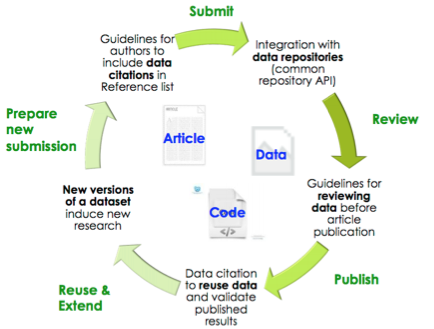
As data publishing technology and data management policies have evolved over the past decade, more academic journals are working with data repositories to disseminate the data associated with published articles. The Dataverse Project at Harvard University’s Institute for Quantitative Social Science (IQSS)recently received a two year grant (2015-2017) from the Sloan Foundation, in partnership with the Odum Institute at the University of North Carolina at Chapel Hill, to collaborate with a variety of publishers, repositories and the international scientific community in order to integrate and automate data publication with more traditional scholarly communication, thus helping make data sharing and preservation an intrinsic and transparent part of the scholarly publication process.

Friday, 5 December 2014

Data Access and Research Transparency (DA-RT): A Joint Statement by Political Science Journal Editors


From the “Workshop on Data Access and Research Transparency (DA-RT) in Political Science.” Convened by the American Political Science Association (APSA) and hosted by the Inter-university Consortium for Political and Social Research (ICPSR), with support from Syracuse University’s Center for Qualitative and Multi-Method Inquiry (CQMI), and the University of Michigan’s Center for Political Studies (CPS).

September 18-19, 2014, Ann Arbor, MI

October 6, 2014

In this joint statement, journal editors commit their respective journals to the principles of data access and research transparency, and to implementing policies requiring authors to make as accessible as possible the empirical foundation and logic of inquiry of evidence-based research.

http://media.wix.com/ugd/fa8393_da017d3fed824cf587932534c860ea25.pdf

An introduction to the basics of Research Data (video)

Published on Oct 28, 20

An animated video explaining the basics of research data created by Louise Patterton, CSIR Library and Information Services, Research Data Management, Pretoria, South Africa.


"This video is recommended background material for students planning to attend a workshop on research data management. Feedback from previous workshops have indicated that many workshop attendees do not have a clear concept of what research data entails, and have no experience of working with research data. This animated video has as its purpose the explanation of the basics of research data, in a simplistic, entertaining and interesting manner. It is hoped that the information contained in the video will better prepare research data novices for a future research data management course/workshop."

What Does All That Healthcare Data Really Mean?

Amid the push to open access to more healthcare data, government and industry officials caution that datasets must come with context.

 (CIO (US)) on 

Confusion over publisher’s pioneering open-data rules

The Public Library of Science’s open-data mandate has prompted scientists to share more data online, but not everyone is complying with the regulations.


Nature article 26 November 2014 - http://www.nature.com/news/confusion-over-publisher-s-pioneering-open-data-rules-1.16409 

Thursday, 4 December 2014

Recommendations for the Role of Publishers in Access to Data

http://dx.doi.org/10.1371/journal.pbio.1001975

Abstract


As appeals for public access of research data continue to proliferate, many scholarly publishers—alongside funders, institutions, and libraries—are expanding their role to address this need. Here we outline eight recommendations and a set of suggested action items for publishers to promote and contribute to increasing access to data. This call to action emerged from a summit that brought together data stewardship leaders across stakeholder groups. The recommendations were subsequently refined by the community as a result of public input gathered online and in meetings.

Chief scientist urges strategic research funding


FYI. tab 10 on the interactive box lists 'Data Format' as one of the STEM Output cited sub-fields. And the bottom of the list outlines areas where Australia has higher citations than the US.

Tuesday, 2 December 2014

Unpacking open data:Power, Politics and the influences of infrastructures

A new paper compares 12 open data policies from around the world to assess their impact and the conditions that lead to effective open data initiatives.
Tim Davies (@timdavies) is a social researcher with interests in civic participation and civic technologies. He has spent the last five years focussing on the development of the open government data landscape around the world, from his MSc work at the Oxford Internet Institute on Data and Democracy, the first major study of data.gov.uk, through to leading a 12-country study on the Emerging Impacts of Open Data in Developing Countries for the World Wide Web Foundation.
A broad coalition of companies, governments, and other entities have come together to open data. This work is based on the belief that opening data creates myriad benefits to society, for transparency, for economic value, and other benefits.
Does open data reconfigure power relationships in the political space? The past, promise, and reality of open data reminds wide.

For the last 5 years, Tim's been following the spread of open data policy and practice, initially in the UK and then increasingly around the world. He's starting from the desire that those people affected by decisions have a role in shaping those decisions, and asks whether there are certain open data structures and practices that achieve this normative goal.
Today, the impact of open data is often anecdotal. Tim seeks not only to prove whether open data is impactful, but also what conditions improve the chances that it is.
He puts forward three null hypotheses:
H1: Open data is not delivering widespread inclusive civic engagement;
H2: Open data is not delivering scalable innovation;
H3: Open data is not substantially shifting the balance of power between citizen and state.
The Open Data Barometer
Open Data Research following the usage of open data in 12 developing countries and developing standards:http://standard.open-contracting.org/.
FROM
https://civic.mit.edu/blog/mstem/unpacking-open-data-power-politics-and-the-influence-of-infrastructures

Friday, 28 November 2014

Soil and Landscape Grid
of Australia

Landscape Attribute Details

Detailed descriptions of all the products available in the Australian Soil and Landscape Grid can be viewed in the CSIRO Data Access portal metadata records
The landscape attribute products available from the Soil and Landscape Grid of Australia were derived from DEM-S, the smoothed version of the national 1 second resolution Digital Elevation Model, which was derived from the 1 second resolution Shuttle Radar Topography Mission (SRTM) data acquired by NASA in February 2000.

Available Landscape Attributes

AttributeDescription
Slope (%)Slope measures the inclination of the land surface from the horizontal.
Slope (%) Median 300m RadiusThe median slope within a 300 m radius representing the typical slope in the local landscape.
Slope Relief ClassificationSlope relief landform pattern classification based on Speight (2009).
AspectAspect measures the direction in which a land surface slope faces. The direction is expressed in degrees from north.
Relief 1000m RadiusThe elevation range measures the full range of elevations within a 1000m circular radius and can be used as a representation of local relief.
Relief 300m RadiusThe elevation range measures the full range of elevations within a 300m circular radius and can be used as a representation of local relief.
Topographic Wetness IndexTWI estimates the relative wetness within moist catchments, but is more commonly used as a measure of position on the slope with larger values indicating a lower slope position.
Topographic Position IndexTopographic Position Index (TPI) is a topographic position classification identifying upper, middle and lower parts of the landscape.
Partial Contributing AreaContributing area in m2 computed using multiple flow directions on hillslopes and ANUDEM-derived flow directions in channels.
MrVBFMrVBF is a topographic index designed to identify areas of deposited material at a range of scales based on the observations that valley bottoms are low and flat relative to their surroundings and that large valley bottoms are flatter than smaller ones.
Plan CurvaturePlan (or contour) curvature is the rate of change of aspect (across the slope) and represents topographic convergence or divergence.
Profile CurvatureProfile curvature is the rate of change of potential gradient down a flow line and represents the changes in flow velocity down a slope.
Prescott IndexThe Prescott Index is a measure of water balance that is sensitive to regional climate and local topography and has proven to be a useful in soil mapping both to stratify study areas for sampling and as a quantitative predictor of soil properties.
SRAD Net Radiation JanuaryMean monthly solar radiation was modelled across Australia using topography from the 1 second resolution SRTM-derived DEM-S and climatic and land surface data.
SRAD Net Radiation JulyMean monthly solar radiation was modelled across Australia using topography from the 1 second resolution SRTM-derived DEM-S and climatic and land surface data.
SRAD Total Shortwave Sloping Surface JanuaryMean monthly solar radiation was modelled across Australia using topography from the 1 second resolution SRTM-derived DEM-S and climatic and land surface data.
SRAD Total Shortwave Sloping Surf JulyMean monthly solar radiation was modelled across Australia using topography from the 1 second resolution SRTM-derived DEM-S and climatic and land surface data.

Spatial Characteristics

All of the products in the Australian Soil and Landscape Grid conform to the spatial structure specified in the GlobalSoilMap Specifications. Below is a summary of the spatial characteristics of the Landscape Attribute prodcuts.

http://www.clw.csiro.au/aclep/soilandlandscapegrid/ProductDetails-LandscapeAttributes.html

Monday, 24 November 2014

Check list available for social science researchers; - assume it could also be used to identify relevant areas that should be addressed in a policy.

http://www.gesis.org/fileadmin/upload/trainingcenter/images__documents/Research_data_management_questions.pdf


Over 1,000 research data repositories indexed in re3data.org

in August 2012 re3data.org – the Registry of Research Data Repositories went online with 23 entries. Two years later the registry provides researchers, funding organisations, libraries and publishers with over 1,000 listed research data repositories from all over the world making it the largest and most comprehensive online catalog of research data repositories on the web. re3data.org provides detailed information about the research data repositories, and its distinctive icons help researchers easily identify relevant repositories for accessing and depositing data sets.

To more than 5,000 unique visitors per month re3data.org offers reliable orientation in the heterogeneous landscape of research data repositories. An average of 10 repositories are added to the registry every week. The latest indexed data infrastructure is the new CERN Open Data Portal: http://service.re3data.org/repository/r3d100011381

The project partners from the US and Germany are very happy about the steady growth and the success of the project.

re3data.org encourages funders, libraries and publishers to refer to re3data.org in their policies and guidelines as the primary source for identifying research data repositories.

Initial partners in re3data.org are the Berlin School of Library and Information Science at the Humboldt-Universität zu Berlin, the Library and Information Services department (LIS) of the GFZ German Research Centre for Geosciences, and the KIT Library at the Karlsruhe Institute of Technology (KIT).

This march re3data.org started a process of merging with Databib (http://databib.org), a similar initative at the University Purdue (West Lafayette, Indiana, USA). The aim of this cooperation is to serve the research community with a single, sustainable registry of research data repositories that incorporates the best features of both initiatives.

All records from Databib are now integrated in re3data.org. The process of merging will be finalised in the next months. By the end of 2015, re3data.org will become an imprint of DataCite and be included in its suite of services.

The work of re3data.org is funded by the German Research Foundation (DFG) in Germany and the Institute of Museum and Library Services (IMLS) in the United States.

URL of this announcement:
http://www.re3data.org/2014/11/over-1000-research-data-repositories-indexed-in-re3data-org

Further information:
Website: http://www.re3data.org
Twitter: https://twitter.com/re3data

--------------------------------------------------------------------------------
Heinz Pampel

Helmholtz Association
Helmholtz Open Science Coordination Office

re3data.org - Registry of Research Data Repositories

Helmholtz Centre Potsdam
GFZ German Research Centre for Geosciences
Library of the Albert Einstein Science Park