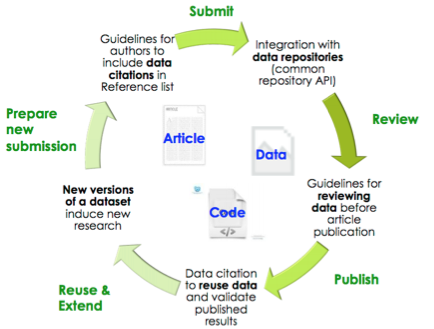
Elsevier has released a report explaining its part in improving “the information system supporting research” over the next decade...
https://www.elsevier.com/connect/elsevier-research-futures-report
Links, stories, images and articles about data-intensive research from Australia and beyond. An unofficial blog created by the Australian Research data Commons (Formerly: Australian National Data Service (ANDS), Nectar & RDS)) for the purpose of recording and sharing external content. ARDC does not endorse the content posted.
Showing posts with label journal. Show all posts
Tuesday, 19 February 2019
Thursday, 8 September 2016
Tuesday, 9 December 2014
A Bridge from Publishing Words to Publishing Data
December 4, 2014
http://datascience.iq.harvard.edu/blog/bridge-publishing-words-publishing-data
Friday, 5 December 2014
Data Access and Research Transparency (DA-RT): A Joint Statement by Political Science Journal Editors
September 18-19, 2014, Ann Arbor, MI
October 6, 2014
In this joint statement, journal editors commit their respective journals to the principles of data access and research transparency, and to implementing policies requiring authors to make as accessible as possible the empirical foundation and logic of inquiry of evidence-based research.
http://media.wix.com/ugd/fa8393_da017d3fed824cf587932534c860ea25.pdf
Monday, 12 May 2014
Peer Review of Datasets: When, Why, and How
Peer review holds a central place within the scientific communication system. Traditionally, research quality has been assessed by peer review of journal articles, conference proceedings, and books. There is strong support for the peer review process within the academic community, with scholars contributing peer reviews with little formal reward. Reviewing is seen as a contribution to the community as well as an opportunity to polish and refine understanding of the cutting edge of research. This paper discusses the applicability of the peer review process for assessing and ensuring the quality of datasets. Establishing the quality of datasets is a multifaceted task that encompasses many automated and manual processes. Adding research data into the publication and peer review queues will increase the stress on the scientific publishing system, but if done with forethought will also increase the trustworthiness and value of individual datasets, strengthen the findings based on cited datasets, and increase the transparency and traceability of data and publications.
This paper discusses issues related to data peer review, in particular the peer review processes, needs, and challenges related to the following scenarios: 1) Data analyzed in traditional scientific articles, 2) Data articles published in traditional scientific journals, 3) Data submitted to open access data repositories, and 4) Datasets published via articles in data journals.
Capsule Summary
Devising methods for data peer review, if done with forethought, can increase the trustworthiness and value of individual datasets and strengthen research findings.
Thursday, 8 May 2014
Journal Article: Nine simple ways to make it easier to (re)use your data
Nine simple ways to make it easier to (re)use your data
Ethan P. White, Elita Baldridge, Zachary T. Brym, Kenneth J. Locey, Daniel J. McGlinn, and Sarah R. Supp
https://peerj.com/preprints/7v1.pdf
Abstract
17 Sharing data is increasingly considered to be an important part of the scientific process. Making your
18 data publicly available allows original results to be reproduced and new analyses to be conducted.
19 While sharing your data is the first step in allowing reuse, it is also important that the data be easy
20 understand and use. We describe nine simple ways to make it easy to reuse the data that you share
21 and also make it easier to work with it yourself. Our recommendations focus on making your data
22 understandable, easy to analyze, and readily available to the wider community of scientists.
Ethan P. White, Elita Baldridge, Zachary T. Brym, Kenneth J. Locey, Daniel J. McGlinn, and Sarah R. Supp
Abstract
17 Sharing data is increasingly considered to be an important part of the scientific process. Making your
18 data publicly available allows original results to be reproduced and new analyses to be conducted.
19 While sharing your data is the first step in allowing reuse, it is also important that the data be easy
20 understand and use. We describe nine simple ways to make it easy to reuse the data that you share
21 and also make it easier to work with it yourself. Our recommendations focus on making your data
22 understandable, easy to analyze, and readily available to the wider community of scientists.
Subscribe to:
Posts (Atom)